

Tantra

What is Tantra?

  • Tantra is not a philosophy or a doctrine, nor a manual on how to become a better lover. It is not intellectual, nor concerned with explaining why things are the way they are or defining truth. Tantra reminds you that you are the vastness of the sky, the space that holds everything.
  • Tantra is an inner revolution. It is the shedding of beliefs, moral conditioning, and mental concepts in order to create the inner space needed to experience infinite and timeless truth. It offers tools for understanding and embracing our true nature, allowing us to love ourselves and others more deeply.
  • Tantra understands duality as the friction that gives rise to life: positive and negative, light and darkness, man and woman, energy and matter, sex and spirit, and so on. When this duality is no longer a conflict in which one side denies the other; when you accept and understand your own duality, life becomes a joyful dance, a celebration.
  • Tantra neither denies nor promotes sex. It simply explores human nature as it is, without moral judgement. A Tantric loves their body, their mind, their heart, and their spirit. Their path to consciousness and joy is the understanding, acceptance, and deepening sensitivity to all of these dimensions.
  • Tantra is a challenge to the taboos and beliefs imposed by any religion or moral code. The great mystics of the Tantric tradition were constantly persecuted and condemned. Although Tantra is a rebellion against moralistic and repressive precepts, it teaches neither libertinism nor pornography, but the intelligent observation of the human being, with all their contradictions, and the acceptance that the body is as divine as the soul, because everything comes from the same source. Quantum physics has also reached the same conclusion: energy and matter are different manifestations of the same reality.

“Many books have been written about Tantra, and all of them speak about technique. But true Tantra has nothing to do with technique. True Tantra cannot be written about, it must be absorbed and lived. True Tantra is not technique, but prayer. It is not oriented towards the head, but towards a relaxation into the heart. Please remember this.”

Osho

Sex is not a race toward anywhere.

When we stop turning sex into a race towards somewhere, or a power struggle in which we make each other responsible for achieving something, or living it through morbidity and the pornographic conditioning imposed by society, and instead learn to bring awareness and love into the experience, we begin to discover that it is a doorway to a profound ecstasy waiting to be awakened.

The pleasure of entertainment-based sexuality represents only a small fraction of our true capacity for love and pleasure. The Tantrics discovered that in the union of the primary polarities, man and woman, masculine and feminine, after a relaxed fusion of at least thirty minutes, electromagnetic energy begins to circulate between the genitals and the hearts of the lovers. If this union continues, it holds the potential to culminate in a communion of ecstasy between body and soul, while also becoming deeply healing.

In the path proposed by Tantra, we learn to free the body from judgements and tensions accumulated through past experiences and beliefs. We learn to release emotional wounds rooted in childhood and intimate relationships, creating the foundation for love to flow naturally, allowing us to trust and become trustworthy. We learn to observe the mind so it can surrender to the present moment and become creative, instead of endlessly repeating outdated and harmful patterns and belief systems. In this way, we create the inner space for energy to move freely and naturally.
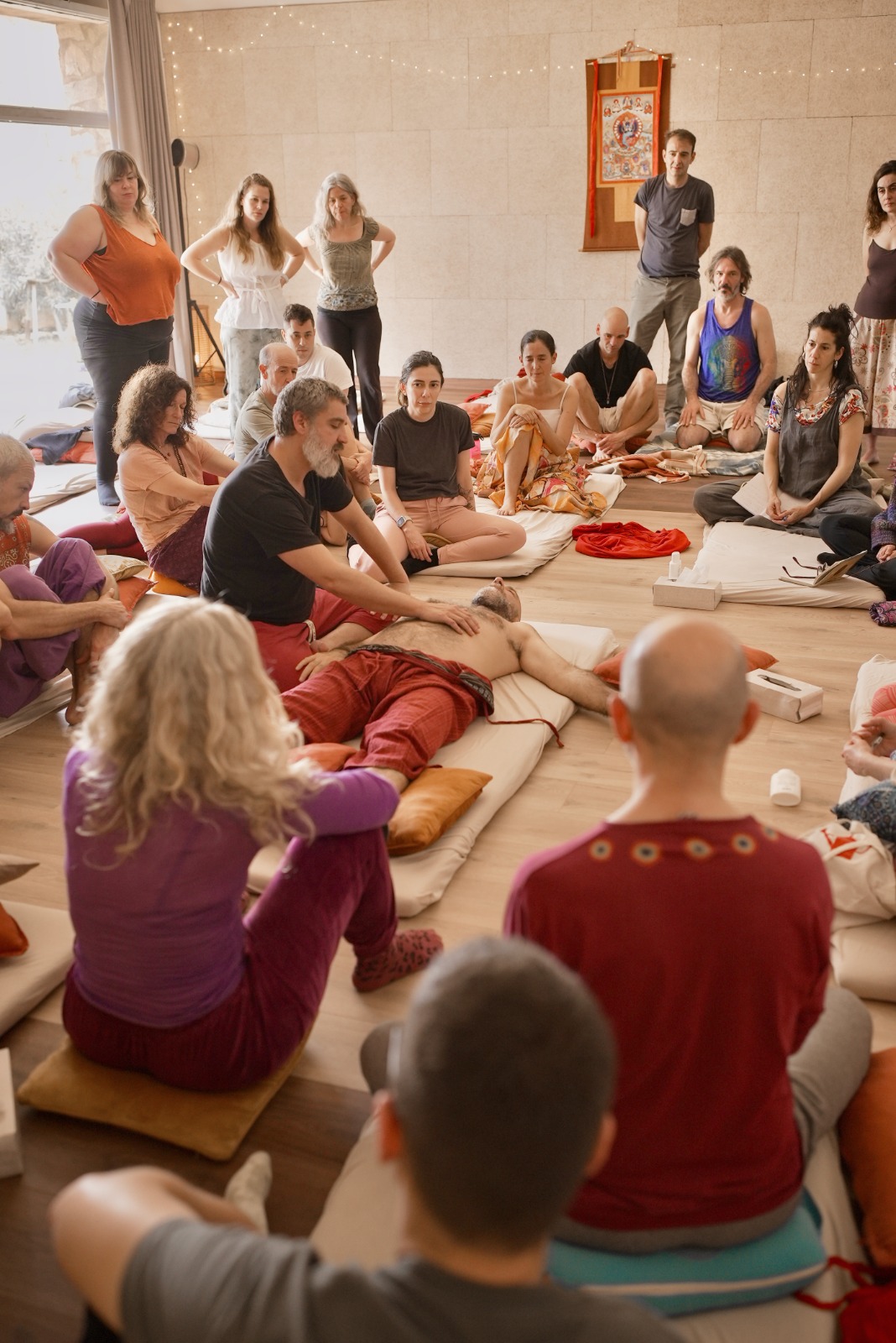
Although The Book of Secrets, the Vigyan Bhairav Tantra, contains 112 meditations, of which only 6 are purely sexual, in the West Tantra is still mostly associated with sexual practices. When I returned from India, I understood that our fascination with sex comes from the fact that, despite believing ourselves to be sexually liberated, very few people are truly fulfilled in their intimate lives. Everyone is searching for something more.

The Origins of Tantra

Tantra simply means “technique.” The Vigyan Bhairav Tantra is a compilation of techniques for awakening consciousness, gathered by Gorakh Nath, a mystic who, around 5,000 years ago, brought together the different Tantric streams in order to unify their teachings. He is also regarded as a reincarnation of Shiva, the enlightened being who symbolizes consciousness in its purest state.

To understand Tantra, it is important to place yourself within the context of ancient India, where an entire civilization, regardless of beliefs or origins, shared a deep interest in the awakening of consciousness and enlightenment. Through this lineage, 112 techniques for reaching that state were passed down. Although ancient, these techniques remain profoundly relevant today because they are essentially scientific keys to awakening.

These techniques are presented through a loving dialogue between Shiva and his beloved consort Shakti, when she asks him to speak about love. Out of these 112 techniques, only about half a dozen deal directly with sexual union. Yet this Tantric approach, which includes sexuality and emotional intimacy as part of the path to awakening, has led to centuries of rejection and persecution of its practitioners.

A human being who understands their own divinity, who has experienced unity, can no longer be fully controlled by limiting beliefs, whether religious or socio-political. For this reason, religions and governments of the time attempted to suppress these currents of practice, turning sex into sin.

Even Osho, one of the great mystics of modern times, who brought these teachings back into the light and translated them into contemporary language, had to endure this condemnation in his own life. As a result of such persecution, many Tantric practitioners fled in different directions, seeking refuge in the Himalayas, China, Tibet, and beyond. This is why different aspects of Tantra have emerged from different regions, just as today each teacher brings their own unique fragrance to the teaching according to their experience and lineage.

In India, you can still find temples standing today, despite the controversy they provoked when they were rediscovered, temples that beautifully reflect the Tantric attitude toward life.

Only around 30 years ago did Tantra begin to re-emerge in the modern world. Tantra is not something that can be learned intellectually, through scriptures, philosophical texts, or manuals. Tantra is a direct experience of life itself. It is an awakening that sometimes requires years of searching, practice, and experience, and at other times arises spontaneously, like a quantum leap. A true teacher does not simply transmit techniques, but becomes a living example, a catalyst for awakening.

Different Tantric Traditions

Shaivite Tantra is devotional in nature. It is a surrender of love to life itself. It is the path of prayer, of absolute acceptance of all manifestations of life, including sex and even death. It honors the god and goddess within every living being, and its practice unfolds through the celebration of the ordinary: through dance, the arts, sensuality, and naturalness.

It is a path of relaxation, of non-effort, of joy. Shiva’s approach is the way of feeling, the way of the heart. Feeling and passion are meant to be transformed until they become prayer. In prayer, the devotee and the divine merge into one. Love and lover dissolve. You and I disappear into a cosmic orgasm, Mahamudra, the Great Gesture, the experience of unity.

Its essential practices are documented in the Vigyan Bhairav Tantra.

It developed through a more disciplined and detached approach in relation to emotions and feelings. Its techniques are used as tools for spiritual awakening. It is a path of self-discipline.

Sex is used only in specific circumstances to generate the energy needed to awaken the Kundalini and activate the nervous system, allowing this energy to rise toward the higher centres and facilitate awakening. It is a more technical path, oriented mainly toward individual practice.

Both paths originated in India and complement one another, just as man and woman do.

Saraha is considered the founder of Buddhist Tantra. His path is the path of meditation and awareness. When the mind no longer clings to any content and great silence arises, emptiness reveals itself: the experience of enlightenment in which the sense of self disappears. Neither you nor I remain. All identifications dissolve, and Shunya appears, the great quantum void, the Nothingness that contains the potential of the unmanifest Whole.

Its practices are meditations designed to cultivate unwavering presence and disidentification from the mind. Sexuality holds a far more symbolic and subtle place within this tradition. Sexual practices are oriented toward the transcendence of the body and the mind. They are often inner or visualisation-based practices, in which one imagines a profound union with the god or goddess.

This Tantric tradition is more oriented toward health alongside spiritual development. A body overflowing with energy is a body that carries a joyful soul and radiates light. In Taoism, sexual meditation practices are considered a path toward health and longevity.

When the body is healthy and full of vitality, energy naturally begins to flow through all the centres of the body, and through this flow awakening can also arise. This tradition includes very specific practices for generating and circulating energy throughout the nervous system. It is a highly technical path.

This term began to emerge more recently and has become associated with Tantra. However, long before patriarchy and male-oriented religions became dominant, many ancient civilizations already understood sexual energy as a force capable of opening expanded states of consciousness and experiences of unity. Native American traditions, Hebrew traditions, the cult of Isis, and the shamanic traditions of many indigenous peoples all recognised this power.

At its essence, this understanding reminds us that sex is the force of life itself. Sexual energy is the source of creativity. The divine uses sexuality as a force of creation.

Therefore, when sexuality is lived consciously, it can become a doorway to awakening. It is also a path of deep communion between the feminine and the masculine. When men and women are able to free themselves from the web of misunderstandings, guilt, wounds, false dogmas, and purely mental sexuality, returning instead to their essential polarity, they can begin to communicate on a profoundly deeper level, allowing energy once again to flow in service of love and creativity.

Nowadays, sacred sexuality workshops are intended to help heal our sexual wounds and guide us back to our essence, or at least they should be.

Each teacher brings their own unique fragrance to the work they share. Follow the wisdom of your heart when choosing who to be guided by.

And finally, I would like to share from my own experience that no matter which path you choose, if you listen to the truth of your heart in every moment, it will become your teacher. When you allow yourself to live your truth courageously, you will eventually be able to let go of all techniques, rules, and doctrines, and simply live naturally as what you already are. You yourself are the springboard that launches you into the ultimate expansion… the emptiness within which the entire universe unfolds.